
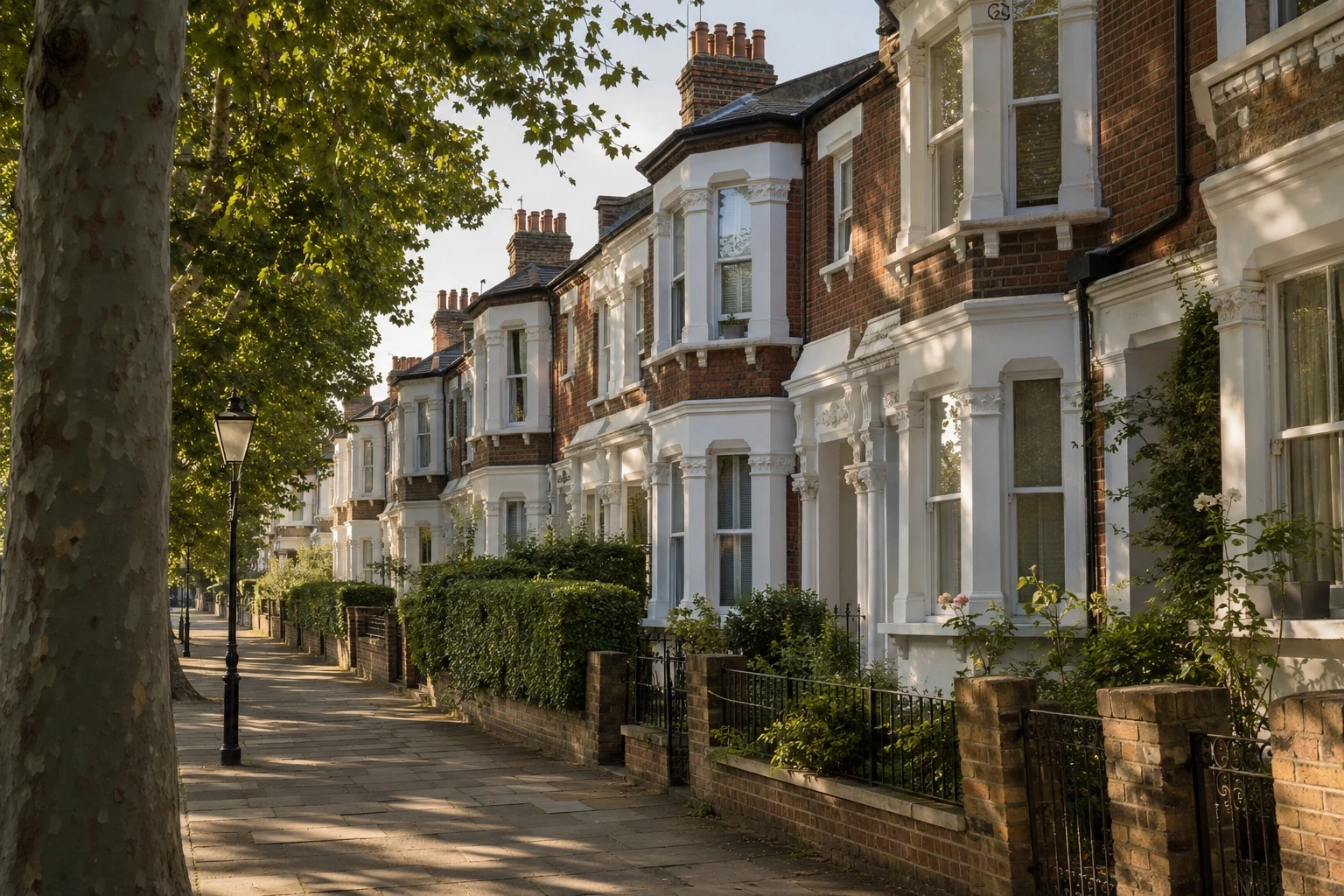
How long does it take to sell a property in West Hampstead?
It depends on what you are selling. For a leasehold flat in NW6 with a mortgaged buyer and a short chain, allow twenty to twenty-eight weeks from accepted offer to completion.
A chain-free freehold house can complete in twelve to sixteen weeks. The England-wide average is around 120 days.
There is a particular optimism to a summer sale. The flat looks its best, the buyer is enthusiastic, everyone talks about being in before the autumn. Then the calendar quietly does its work.
Count forward from an offer accepted today and the time lines become very sobering.
That third line deserves a second look, because it describes the typical West Hampstead sale. Twenty weeks from today is Tuesday 29 December. You would be moving at Christmas — and not in the comfortable sense. The 29th is one of only three working days in the entire fortnight: the 25th and 28th are bank holidays, New Year’s Day is another, and the weekends take everything else.
So the honest version is this. Agree a sale this week at the average pace for a leasehold flat, and Christmas is not a deadline you are working towards — it is the thing you are landing in the middle of. Your realistic options are Thursday 24 December at the latest, the skeleton window of 29 to 31 December when half the chain will be away and lenders are running minimal staff, or Monday 4 January. Funding cut-offs pull that forward again, so most chains aiming for Christmas are really aiming at 22 or 23 December.
There is also a fortnight of drag built into the next few weeks specifically. Conveyancers, mortgage advisers, freeholders’ managing agents and council search teams all take summer leave, and a chain only moves at the speed of whoever is away. The late August bank holiday sits in the middle of it. Nothing is wrong; everyone is simply on holiday at once. Plan for it rather than being surprised by it in September.
Nobody is ignoring you. Everybody is waiting.
The most common question we field is some version of: it has been six weeks, why has nothing happened? The honest answer is that a great deal has happened, almost none of it visible, and most of it consists of one professional waiting on a document from another professional who is waiting on a third.
The national averages that get quoted — twelve to sixteen weeks from accepted offer to completion — describe a chain-free freehold house somewhere with a responsive council. They do not describe a Victorian conversion flat in NW6. For a leasehold London flat in a modest chain, twenty to twenty-eight weeks is the realistic band. The England-wide average now sits at roughly 120 days, a journey about 60% longer than it was in 2007, when the same move took around 75 days.
What follows is an honest map of those weeks, using a typical Homesforth sale: a two-bedroom leasehold flat, buyer with a mortgage, three parties in the chain, offer agreed in mid-August. If you want the shorter overview of each stage, our guide to the selling process and guide to buying cover the formal steps.
Offer to completion, stage by stage: where the twenty weeks go
Read this chart once and the whole process makes sense. The bars are colour-coded by who is actually holding the file — and the longest ones belong to people none of us can telephone and hurry along.
Four bottlenecks that delay a leasehold sale
Almost every slow sale in this postcode is slow for one of four reasons. Three of them can be attacked before a buyer is even found.
The council search
Research published in May put Camden’s average local authority search at 52 working days — more than ten weeks, among the slowest in England. Brent runs faster but not fast. A regulated personal search gathers the same information and typically returns in two to five working days.
The management pack
Six to ten weeks is normal for an LPE1 from a managing agent, and there is no mechanism to compel one. On a share-of-freehold conversion where the directors are the neighbours, it can be faster — or considerably slower.
The standing start
Nothing at all happens until the solicitor is instructed, paid on account and identity-checked. Weeks disappear here before the slowest stage has even begun. Industry data shows the gap from instruction to mortgage offer alone grew from 38 days in 2007 to 59 by 2024.
The chain
Each additional party adds roughly two to four weeks. Chain-free typically completes in twelve to sixteen weeks; three parties in twenty to twenty-eight; five parties can run beyond that and start to threaten a mortgage offer, which most lenders hold open for three to six months.
Week one. If searches are not ordered in the first few days, every subsequent stage inherits the delay, and a mortgage offer with three months left on it starts to look uncomfortably tight. The single most useful sentence a seller or buyer can say to their solicitor is: please order the searches today, and tell me what you need from me to do it.
How your asking price changes your moving date
Everything above concerns the weeks after an offer. But the clock starts earlier, and the stretch before a buyer appears is the one stage almost entirely within your control. It is decided by a single number.
The summer figures set the scene. Asking prices fell 1% in July — around £3,832 off the national average, taking it to £372,359, against a typical July dip of 0.2% over the past decade. Available stock is roughly 1% below last year but still close to a twelve-year high for the time of year, and sales agreed across the first half of 2026 ran about 6% behind 2025, though level with 2024. Buyers have choice, and they are using it.
Set against that, two figures from Rightmove’s July analysis are worth more to a seller than any forecast. 74% of the homes that sold and completed this year did so without a single asking price reduction. And the homes that did need one paid for it in time: an average of 127 days on the market, against just 36 days for those that sold without a reduction.
Put those back into the calendar. Price sensibly, find your buyer in 36 days, add twenty weeks of conveyancing, and you complete in the first week of February. Price optimistically, spend 127 days on the market, and the identical legal process lands you in early May. The asking price is not only a question of what you get. It is a three-month decision about when you move.
Those are national figures, and NW6 runs its own race: comparison data for the postcode puts the typical time to go under offer nearer seventeen weeks across all listings, which is exactly what you would expect in an area of high-value flats where a proportion of stock is tested at an optimistic figure first. The gap between the well-priced and the hopeful is wider here than almost anywhere. A realistic valuation of your property is the cheapest week you will ever buy back.
Mortgage rates are the other half of the equation. The average two-year fixed sits at about 4.92% — higher than the 4.25% of February, before the conflict in Iran pushed borrowing costs up, but easing from last month’s 5.07%. The Bank of England held Bank Rate at 3.75% on 30 July, though three of the nine committee members voted to raise it, and the Bank’s own projection has inflation peaking near 3.2% late this year. Nobody should plan a sale around a forecast, but the direction of travel is no longer obviously downward, and a buyer holding a mortgage offer today is holding something worth protecting.
Six ways to speed up your sale
Instruct your solicitor before you list, not after you accept
Terms signed, identity verified, money on account, and the protocol forms completed — TA6 for the property, TA10 for fittings and contents, and TA7 for the lease if you are selling a flat. That is a fortnight recovered before a buyer has even booked a viewing, and it costs nothing to do early.
Order the management pack the week you go on the market
It is the stage with the longest tail and the least leverage. Requesting it at listing rather than at offer routinely takes a month off a leasehold sale in NW6 — and in August, when managing agents are short-staffed, closer to six weeks.
Ask for a regulated personal search
A regulated provider inspects the same Local Land Charges register and gathers the same CON29 enquiries directly from the council, backed by insurance. Given Camden’s queue, it is the difference between ten weeks and one. Confirm your buyer’s lender accepts personal searches before committing — most do, but not all.
Find the lease problems yourself
Term remaining, ground rent structure, service charge arrears, missing building safety paperwork, an absent freeholder. Every one of these is survivable if it surfaces in week two and expensive if it surfaces in week fourteen.
Choose the buyer, not just the number
A chain-free buyer with a mortgage in principle and a solicitor already instructed is frequently worth more than an extra £10,000 from someone with a flat to sell in a market that has not yet met them.
Name your target completion date out loud, early
If being in before Christmas matters, say so in week one and let every solicitor in the chain hear it. A date nobody has agreed to is a date nobody is working towards, and by November the honest options will have narrowed to around 22 December or the first week of January. Agreeing the target early is what keeps the earlier one available.
The 2026 home buying reforms, and what they change
In June the Ministry of Housing published its Home Buying and Selling Reform Roadmap, which the department describes as the biggest overhaul of the process in a generation. The government’s own case for it is blunt: around 120 days to complete, roughly one in three transactions failing, and about £400 million a year in wasted costs. First-time buyers are projected to save more than £200 million annually once the reforms land.
- Upfront sales packsSearches, condition information, leasehold costs and chain status compiled before a property is listed. Needs primary legislation, so realistically some way off.
- Earlier binding agreementsCommitment closer to the point of acceptance, aimed at gazumping and late collapses. Confirmed as subject to further detailed consultation.
- A Code of Practice for agentsNon-statutory minimum standards, due this year, alongside a consultation on mandatory qualifications for estate and letting agents.
- Digital ID and e-signaturesVerify once rather than separately for the agent, the solicitor and the lender. Already permissible; adoption is the bottleneck, not the law.
- AI in conveyancingApplications to the government’s AI Growth Lab open to law tech and conveyancing firms later this summer, with legal services as its first area of focus.
National Trading Standards has withdrawn its material information guidance, because the Consumer Protection Regulations it was built on were superseded by the Digital Markets, Competition and Consumers Act 2024, with enforcement passing to the Competition and Markets Authority. New government guidance is coming. Until it arrives, the underlying legal duty to disclose still applies — the published checklist that told agents how to meet it does not exist. Ask any agent you instruct how they are handling that in the meantime.
Most of the roadmap is phased across this Parliament, so nothing announced in June changes a transaction running today. But you can adopt the upfront-pack principle voluntarily right now, and the arithmetic is not in dispute: the search and the management pack are the two longest bars in the chart above. Commission them before you list and those weeks come out of your buyer’s wait instead of being added to it. You do not have to wait for Parliament to get the benefit.
Why NW6 runs slower than the national average
Three local characteristics stack against us, and it is better to plan around them than be surprised by them.
Almost everything here is leasehold. West Hampstead, Kilburn and Kensal Rise are built on Victorian and Edwardian houses divided into flats, which means a lease, a freeholder or a share-of-freehold company, a management pack and a service charge history on nearly every sale. Freehold houses move on a different, faster clock.
Camden is one of the slowest search authorities in England, and much of our patch sits inside it. Brent is better but not immune. If you are buying across the borough line — and plenty of people in Kilburn are — it is worth knowing which side of the road you are on before anyone quotes you a timescale.
Finally, our chains tend to be long. This is an area people move within rather than into or out of: a one-bed becomes a two-bed becomes a garden flat, all inside the same square mile. That is excellent for values and unhelpful for timelines.
None of which makes a smooth sale unusual. It makes preparation the whole game.


